ADVERTISEMENT
ADVERTISEMENT
Endometriosis: a whole-body, whole-life struggle…
• Fibromyalgia & widespread pain: About 7% of endo patients (my wife included) also have fibromyalgia. In these cases, pain can be widespread all over the body, and traditional endo surgery doesn’t fix it. A study found that women with both endo and fibromyalgia had much worse pain and higher rates of other autoimmune issues. If your partner has generalized body aches on top of pelvic pain, don’t dismiss it, it’s a known comorbidity.
• Mental health changes: We said we’re not giving psychological advice, but it’s important: chronic endo pain often leads to anxiety and depression. One review notes that the “unpredictable, disabling” nature of endo deeply affects quality of life, causing clinically significant depression and anxiety in many patients. Women may feel grief and frustration over plans cancelled, or guilt about not being “normal.” Partners need to recognize this mental load as part of the disease, it’s not just a mood issue, but a direct result of constant pain and loss of normal life. In fact, endo patients have higher rates of depression and anxiety than women with other chronic pain conditions.
• Infertility: As mentioned, endo is a leading cause of infertility. Up to half of infertile patients have some endo lesions. Even when pregnancy eventually occurs (natural or via IVF), the struggle to get there and the loss of privacy (tracking cycles, tests, procedures) adds huge stress. Partners should know that fertility treatments can work with endo, but it often takes longer and more interventions.
Important misconception!
The severity of symptoms often does not match what doctors see. It is well-known that some women with minimal visible lesions have excruciating pain, while others with extensive “stage IV” endo tolerate it better.
Scans like ultrasound or MRI can easily miss deep implants. So if your partner is in agony but the report says “normal,” believe her. The experts now explicitly caution doctors against dismissing her pain just because scans look clear.
Endometriosis can hide in unexpected places…
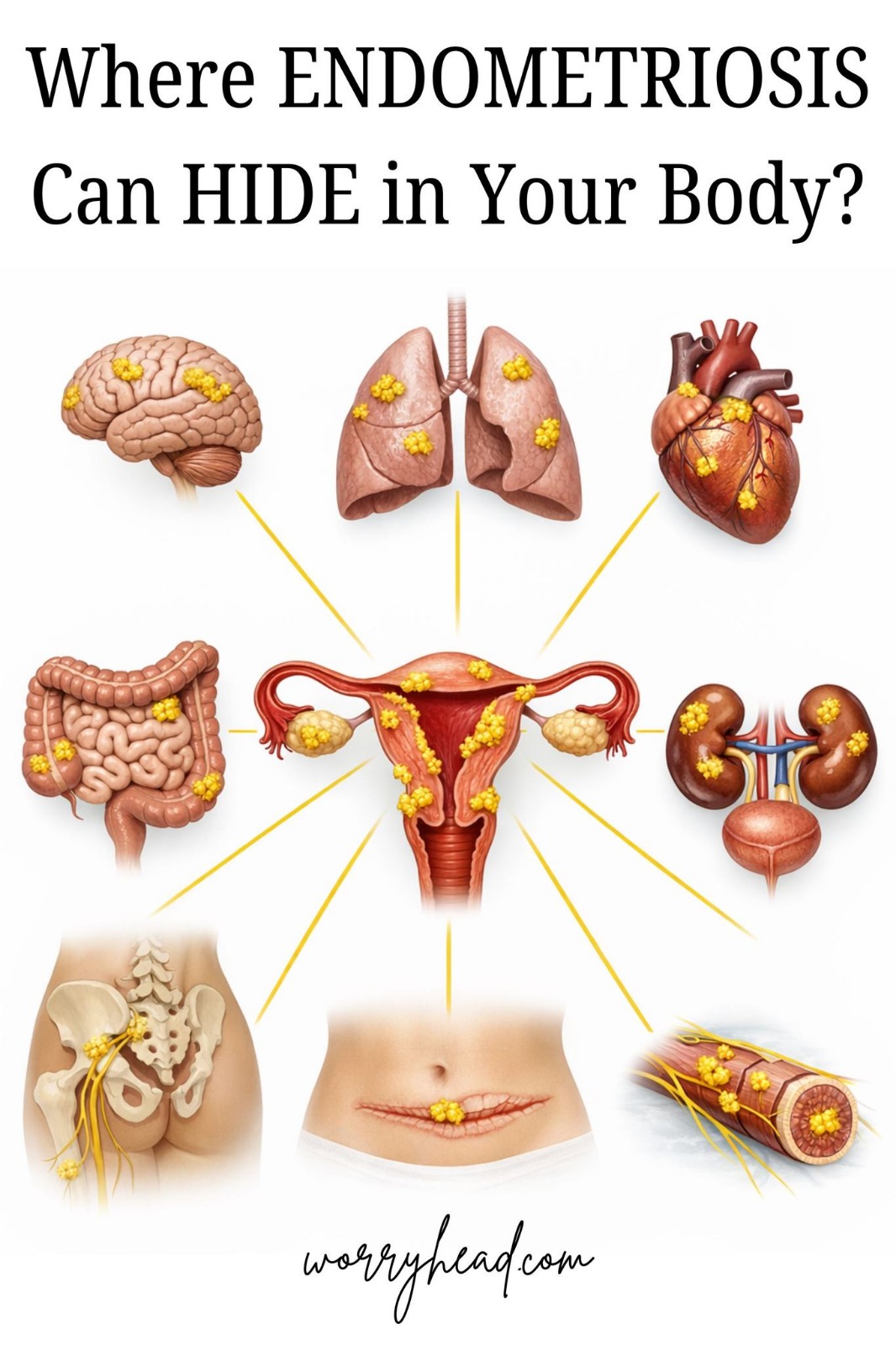
Endo is a “great masquerader.” Here are some unusual organ sites documented in medical literature, and what symptoms they cause. If your partner ever has cyclical pain in these areas, take it seriously:
• Diaphragm & lungs  : Tiny implants on the diaphragm (muscle under the lungs) or pleura can lead to catamenial pneumothorax. This means a lung collapse that happens every month around her period. She may complain of sudden one-sided chest or shoulder pain, difficulty breathing, or coughing blood only during her menstrual week. Doctors have reported women undergoing multiple lung surgeries (thinking it was a lung problem) before realizing endo was the cause. Always mention the timing of symptoms to her physicians.
: Tiny implants on the diaphragm (muscle under the lungs) or pleura can lead to catamenial pneumothorax. This means a lung collapse that happens every month around her period. She may complain of sudden one-sided chest or shoulder pain, difficulty breathing, or coughing blood only during her menstrual week. Doctors have reported women undergoing multiple lung surgeries (thinking it was a lung problem) before realizing endo was the cause. Always mention the timing of symptoms to her physicians.• Heart (pericardium)  : On extremely rare occasions, endo has been found on the pericardium (the sac around the heart). This can cause cyclic chest pain or pericardial effusion (fluid around the heart) that worsens with menstruation. There are case reports of “unexplained” cyclic chest pain that resolved after removing an endometrial implant on the heart. Again, if she has chest-related symptoms that are tied to her cycle, push for investigation.
: On extremely rare occasions, endo has been found on the pericardium (the sac around the heart). This can cause cyclic chest pain or pericardial effusion (fluid around the heart) that worsens with menstruation. There are case reports of “unexplained” cyclic chest pain that resolved after removing an endometrial implant on the heart. Again, if she has chest-related symptoms that are tied to her cycle, push for investigation.• Bowel/rectum  : We covered this above, but to reiterate, deep implants can invade the bowel wall. Think of severe cramps whenever she moves her bowels, or bright red blood in stool during her period. Some women have pain and urgency so bad they schedule bathroom breaks tightly around their cycle. This often leads doctors down a digestive-illness path first. Always consider endo if GI issues flare cyclically.
: We covered this above, but to reiterate, deep implants can invade the bowel wall. Think of severe cramps whenever she moves her bowels, or bright red blood in stool during her period. Some women have pain and urgency so bad they schedule bathroom breaks tightly around their cycle. This often leads doctors down a digestive-illness path first. Always consider endo if GI issues flare cyclically.• Bladder & ureters  : Similarly, implants on the bladder can cause sharp bladder pain or constant “fullness” during periods. Painful urination (dysuria) during menses is a clue. When the ureter is affected, she may have one-sided back pain or kidney pain that comes and goes. We mentioned how dangerous a silent kidney blockage is, an ultrasound or CT can reveal it. Partners should be aware: recurring UTIs in sync with menses may actually be endo.
: Similarly, implants on the bladder can cause sharp bladder pain or constant “fullness” during periods. Painful urination (dysuria) during menses is a clue. When the ureter is affected, she may have one-sided back pain or kidney pain that comes and goes. We mentioned how dangerous a silent kidney blockage is, an ultrasound or CT can reveal it. Partners should be aware: recurring UTIs in sync with menses may actually be endo.• Nerves & pelvic floor  : Endo lesions can wrap around pelvic nerves. For example, the sciatic nerve (which runs through the pelvis) can be trapped, causing monthly “sciatica” (burning leg or hip pain). The pudendal nerve (supplying the vulva/anus) can also be entrapped, leading to cyclic vulvar burning or pain on sitting. These nerve pains often baffle doctors. Chronic nerve sensitization means even normal pressure (like sitting on a bicycle seat) can become excruciating during a flare. Partners should know: if she complains of worsening nerve-type pain each cycle, this is a known endo complication.
: Endo lesions can wrap around pelvic nerves. For example, the sciatic nerve (which runs through the pelvis) can be trapped, causing monthly “sciatica” (burning leg or hip pain). The pudendal nerve (supplying the vulva/anus) can also be entrapped, leading to cyclic vulvar burning or pain on sitting. These nerve pains often baffle doctors. Chronic nerve sensitization means even normal pressure (like sitting on a bicycle seat) can become excruciating during a flare. Partners should know: if she complains of worsening nerve-type pain each cycle, this is a known endo complication.• Surgical scars & skin  : After any abdominal surgery, endo cells can seed the scar. The classic sign is a C-section or laparoscopy scar that becomes a tender nodule. It swells, turns red, or even bleeds slightly during her period. Some women found lumps that doctors assumed were hernias or cysts, but imaging and biopsy proved endo. If she ever mentions a painful lump in a scar, insist it be checked. This is called “scar endometriosis” and, while rare (0.03–0.4% of C-sections), it does happen.
: After any abdominal surgery, endo cells can seed the scar. The classic sign is a C-section or laparoscopy scar that becomes a tender nodule. It swells, turns red, or even bleeds slightly during her period. Some women found lumps that doctors assumed were hernias or cysts, but imaging and biopsy proved endo. If she ever mentions a painful lump in a scar, insist it be checked. This is called “scar endometriosis” and, while rare (0.03–0.4% of C-sections), it does happen.Read more on next page
ADVERTISEMENT
