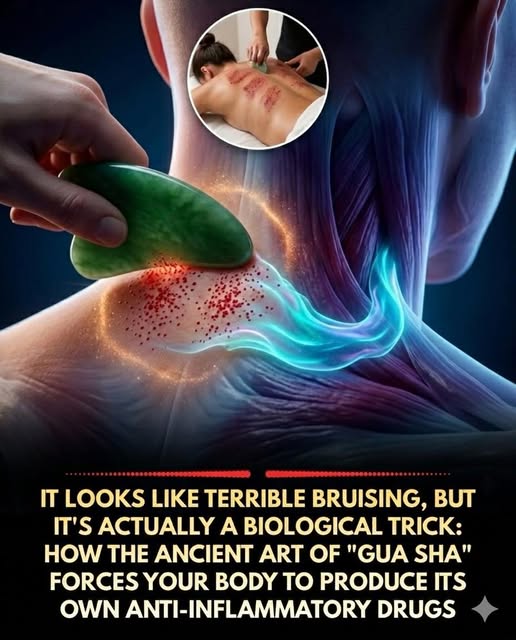
If you have ever seen an Olympic swimmer with dark red circles on their back, you have seen “Cupping.” But there is an even older Traditional Chinese Medicine (TCM) technique that looks far more brutal, yet is profoundly effective: Gua Sha (or “Scraping”).
In Western physical therapy, it is now known as Instrument-Assisted Soft Tissue Mobilization (IASTM) or the Graston Technique.
To the uninitiated, it looks like you are severely bruising the skin. But biologically, you are hacking the body’s repair system.
Petechiae vs. Bruising
A normal bruise is caused by blunt force trauma that crushes blood vessels, causing deep internal bleeding and tissue damage.
Gua Sha is different. By repeatedly scraping a smooth stone over lubricated skin, you create intentional, highly controlled friction. This pulls stagnant, deoxygenated blood out of the deep muscle capillaries and up to the surface of the skin, creating tiny red or purple dots called Petechiae (in TCM, this is called the “Sha”).
You aren’t crushing the tissue; you are essentially vacuuming the stagnant metabolic waste to the surface.
The HO-1 Enzyme Miracle
Why purposely create petechiae? Because of the biochemical response.
When your immune system detects these tiny pools of blood at the surface, it panics. It thinks there is a massive injury.
To manage this “fake” injury, your cells massively upregulate an enzyme called Heme Oxygenase-1 (HO-1).
HO-1 is one of the most powerful antioxidant and cytoprotective enzymes in the human body. It breaks down the heme (from the red blood cells) into carbon monoxide and biliverdin, which act as extreme, localized anti-inflammatories.
The Hack: The HO-1 floods the entire area. It doesn’t just clear the red marks; it penetrates deep into the muscle fascia, putting out the fire of chronic, decades-old inflammation and tension that a normal massage could never reach.
Fascial Remodeling
Beyond the enzymes, the physical scraping breaks up fascial adhesions—the “glue” that binds muscle fibers together when we sit at desks all day. It physically reorganizes the collagen matrix, restoring immediate mobility and range of motion.
ADVERTISEMENT
ADVERTISEMENT
