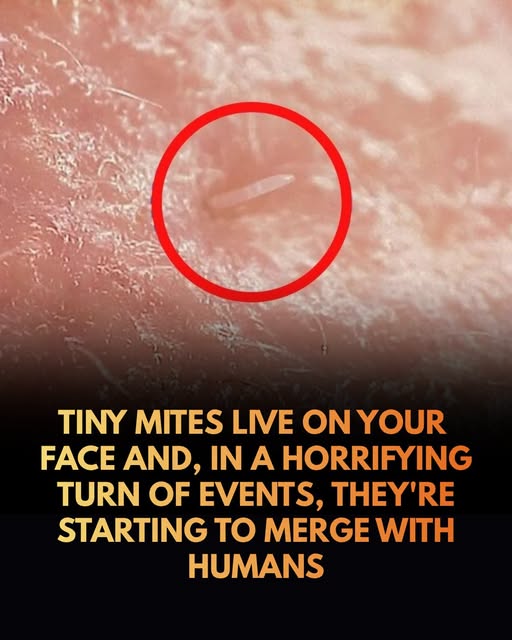


What Do They Eat?
Contrary to popular belief, these mites do not feed on living skin.
Instead, they consume:
- Dead skin cells
- Skin oils (sebum)
- Cellular debris naturally produced by the skin
Because our skin continuously renews itself, this provides a steady food supply throughout their approximately three-week lifespan.
Scientists suspect that, in normal numbers, this feeding behavior may help remove small amounts of accumulated debris from hair follicles.
An Extraordinary Evolutionary Discovery
A landmark genetic study published in Molecular Biology and Evolution examined the genome of Demodex folliculorum and uncovered something unexpected.
Because these mites live in one of the safest environments imaginable—the protected interior of human hair follicles—they experience very little environmental pressure compared with free-living organisms.
Over millions of years they have gradually lost genes that are no longer necessary.
Among the genes that have been reduced or eliminated are those involved in:
- Protection against ultraviolet light.
- Maintaining daytime activity.
- Producing melatonin-related biological functions.
- Coping with changing environmental conditions.
As a result, Demodex now possesses one of the smallest genomes known among related mite species.
This process, known as genome reduction, is common among organisms that become highly specialized for living in stable environments.
ADVERTISEMENT
