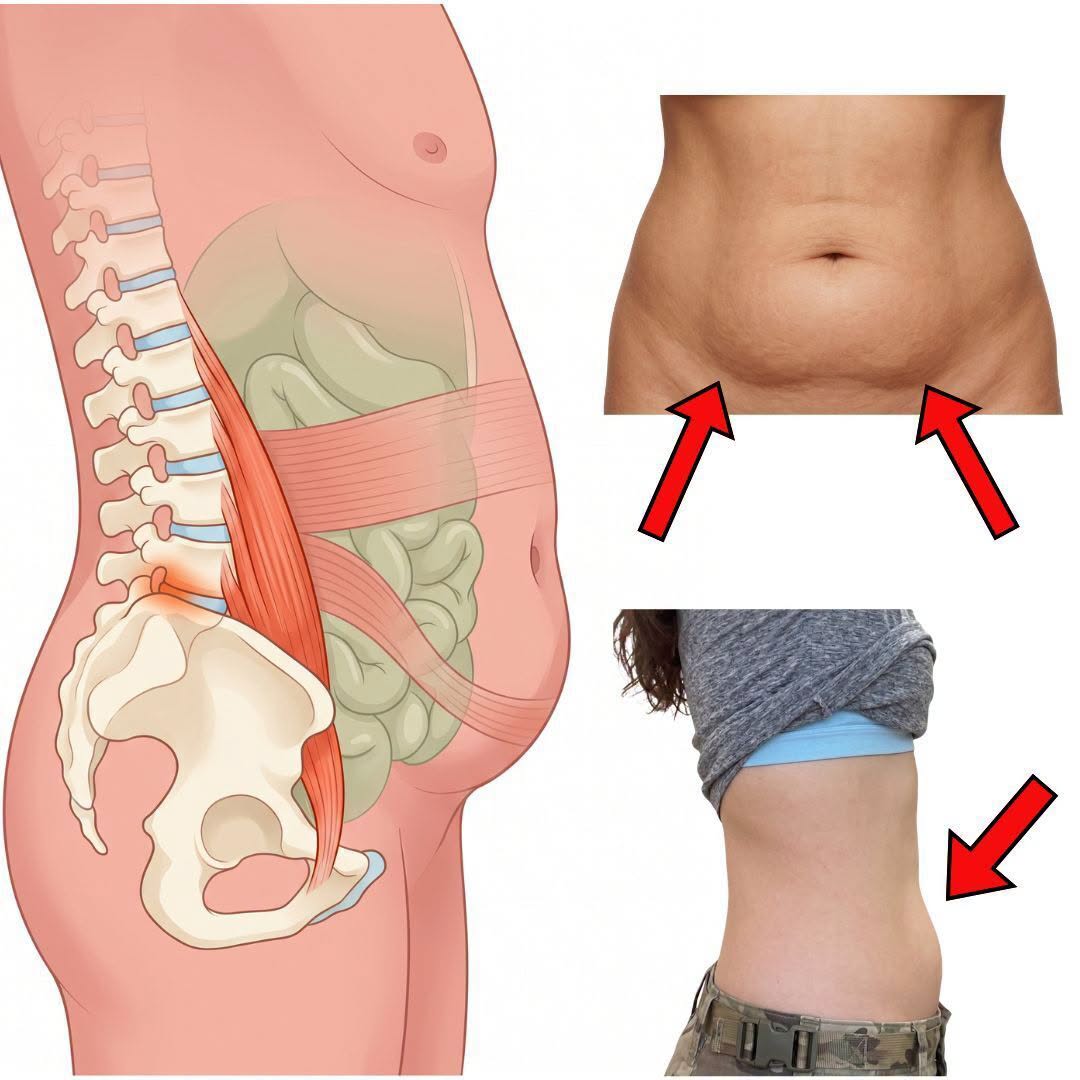
A Protruding Lower Belly and Lower Back Pain: Two Sides of the Same Coin (And One Common Reason Behind Them)
Many people—even those who aren’t overweight—notice that their lower abdomen tends to protrude.
This is especially common in women, and it’s no coincidence.
It’s not just a cosmetic concern. In many cases, it reflects a muscular imbalance that can also affect the spine—particularly the lower back.
Today, we’ll explore why a protruding lower belly can sometimes be linked to the way your core functions, why many people with this issue also experience stiffness or discomfort in their lower back, and which muscle plays the biggest role in supporting both.
🥅 Why the Lower Abdomen Is the First Area to Bulge
Let’s begin with something that changes the way we think about the abdomen.
Place your hand above your belly button. Beneath your fingers, you’ll feel your rib cage—a solid bony structure that protects and supports the upper part of your abdomen.
Now move your hand below your belly button.
There are no ribs there.
Instead, the lower abdomen relies primarily on muscles for support—especially a deep core muscle called the transverse abdominis.
Because there is no bony framework in this region, the lower abdomen depends heavily on this muscle to help support the abdominal contents.
That’s why it’s often the first area to protrude when deep core support isn’t functioning optimally.
ADVERTISEMENT
ADVERTISEMENT
