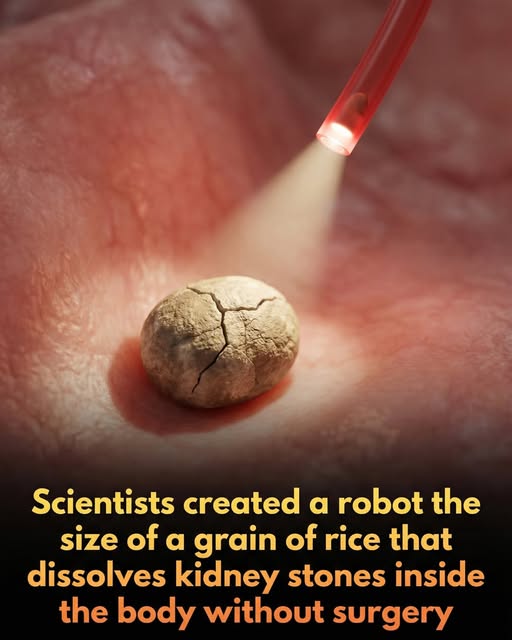
Kidney stones are among the most painful medical conditions many people experience. Traditionally, treatment options have included medications that take months to work, shock-wave therapy, or even surgery. But scientists are now developing an extraordinary new solution: a micro-robot designed to dissolve kidney stones from inside the body.
This groundbreaking technology could one day transform how doctors treat urinary tract stones, making procedures safer, faster, and far less invasive.
A New Generation of Medical Robots
Researchers have created a soft, flexible robotic filament made from hydrogel, measuring only about one centimeter long. Despite its tiny size, this micro-robot carries a powerful tool: an enzyme called urease, which can chemically break down uric acid kidney stones.
Instead of relying on large surgical tools or external shock waves, doctors could guide this tiny robot directly to the stone through the urinary tract.
What makes this device even more remarkable is how it moves.
The robot is controlled by a rotating magnetic field generated by an external robotic system. By adjusting the magnetic signals, doctors can carefully steer the filament through narrow pathways inside the body.
Throughout the procedure, ultrasound imaging allows physicians to monitor the robot’s position in real time, ensuring precise and safe navigation.
How the Robot Breaks Down Kidney Stones
Once the micro-robot reaches the kidney stone, it releases the enzyme urease directly at the site.
This enzyme works by changing the local pH level in the surrounding environment. The altered chemistry gradually weakens the uric acid stone, causing it to break down into much smaller fragments.
These tiny fragments can then pass naturally through the urinary system, eliminating the need for surgical removal.
This targeted approach means the treatment focuses only on the stone itself, leaving surrounding tissues largely unaffected.
ADVERTISEMENT
ADVERTISEMENT
