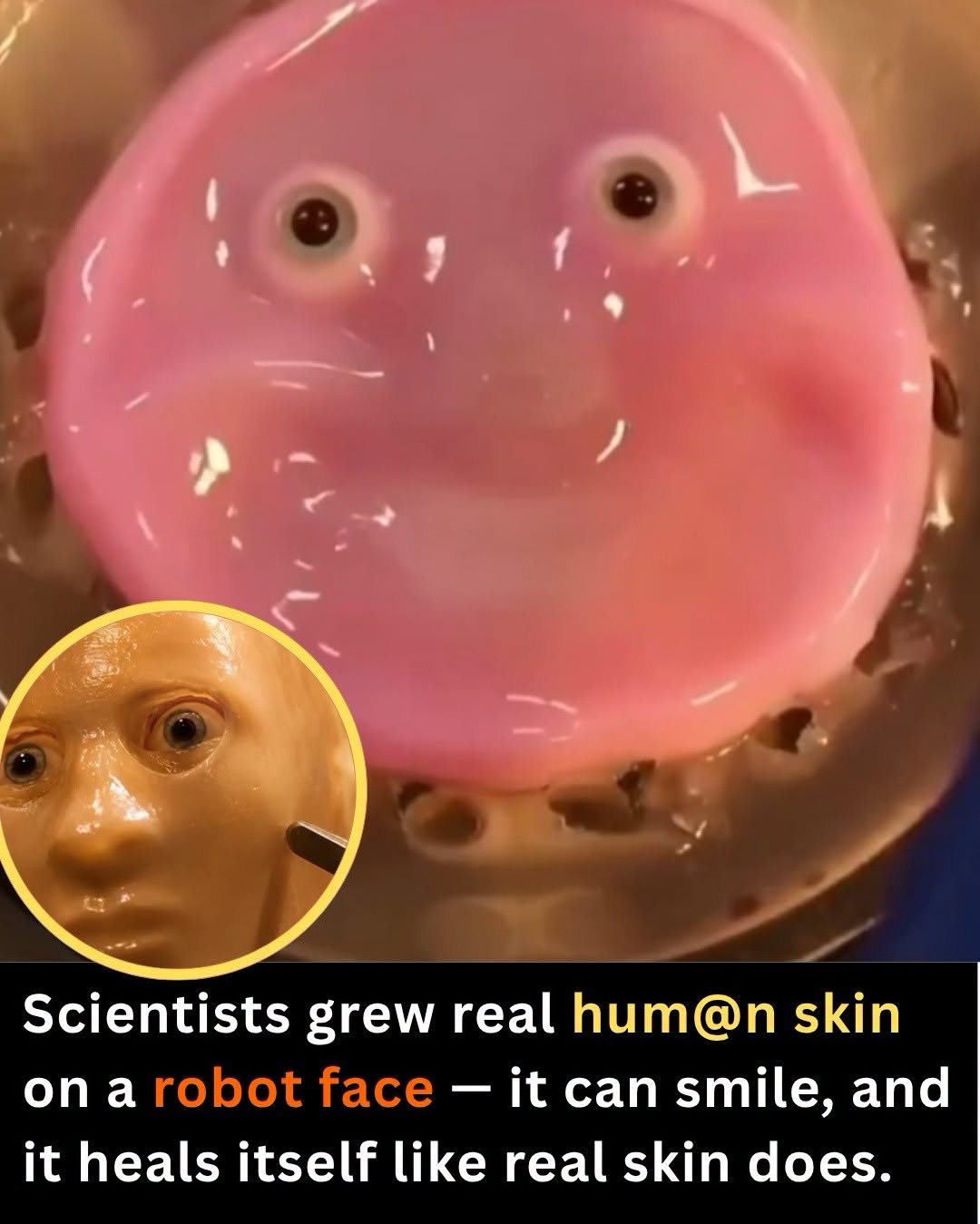
The research was published in the peer-reviewed journal Cell Reports Physical Science in June 2024, confirming that this is not CGI, a concept design, or a futuristic animation. It is a real scientific breakthrough achieved inside a laboratory in Tokyo.
This accomplishment builds on the team’s earlier success in 2022, when they covered a robotic finger with living skin. Their next goal is even more ambitious: integrating blood vessels, sweat glands, nerve endings, hair follicles, and sensory capabilities to create a fully functional biological covering that behaves increasingly like human skin.
While the idea of robots with living skin may sound unsettling, the researchers emphasize that the technology is intended for far more than building human-like machines. Its potential applications could revolutionize medicine and biomedical research, including:
• Training plastic and reconstructive surgeons using realistic living tissue.
• Developing improved skin grafts for burn victims and patients with severe injuries.
• Testing cosmetics and pharmaceuticals on living human tissue without involving human volunteers.
• Advancing regenerative medicine and tissue engineering.
• Creating more lifelike prosthetic limbs that better integrate with the human body.
This innovation represents a major step forward in the merging of biology and robotics. Although truly human-like robots remain a long way off, scientists are steadily moving toward machines that not only look more human but also possess living biological components capable of growing, adapting, and healing.
The line between biology and technology is becoming thinner than ever before.
The question is no longer whether robots can resemble humans.
It’s how close they will eventually become.
ADVERTISEMENT
