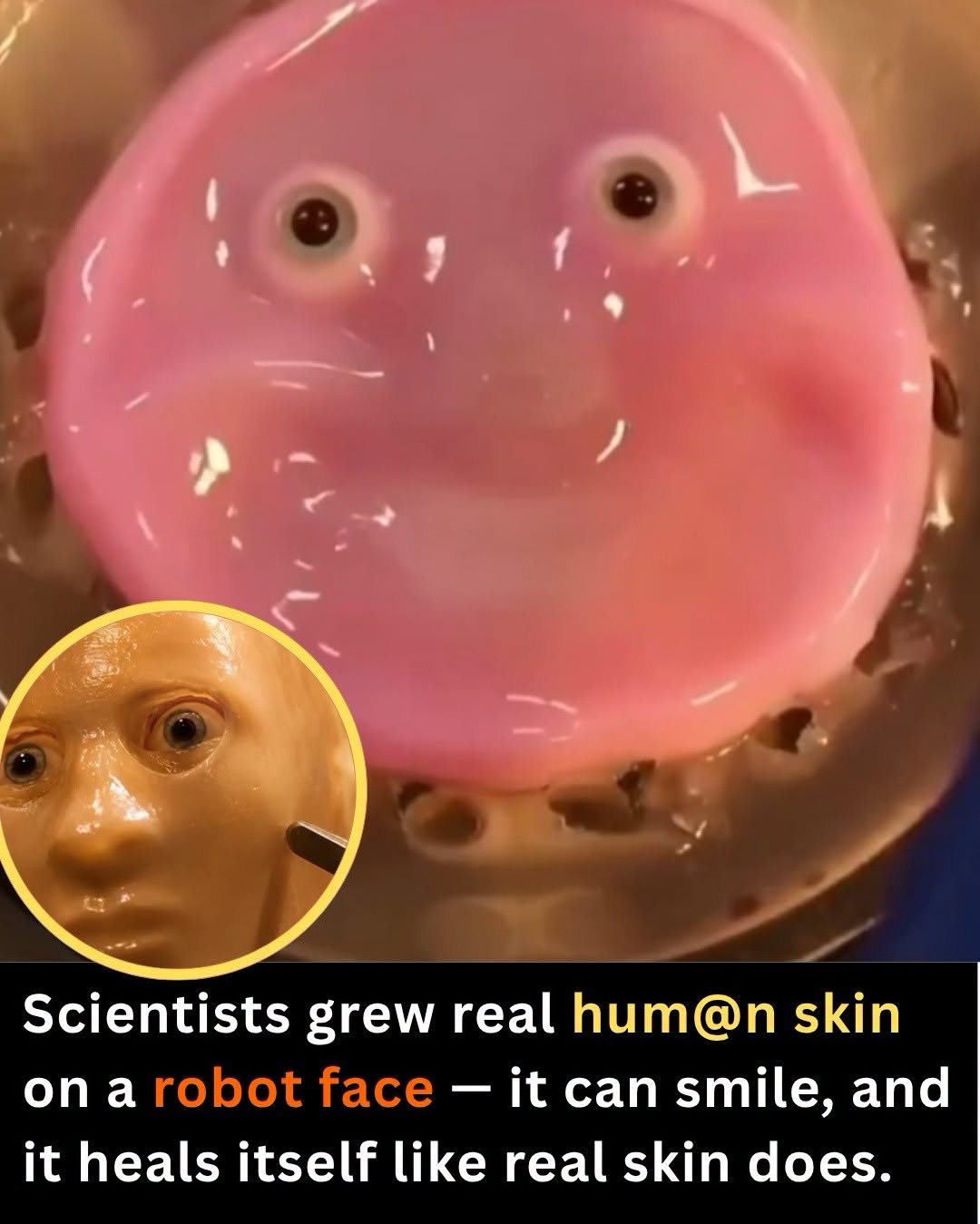
What once seemed possible only in science fiction has now become a remarkable scientific achievement. Researchers at the University of Tokyo have successfully created a robot face covered with living human skin that can smile, stretch, and even repair itself after being damaged.
Unlike traditional humanoid robots that rely on silicone or synthetic materials, this breakthrough uses real living human skin cells grown in the laboratory. To securely attach the skin to the robot’s face, scientists engineered thousands of tiny V-shaped perforations that mimic the ligaments anchoring human skin to the tissues beneath it. This innovative design allows the skin to flex, stretch, and move naturally without peeling or tearing.
When the robot smiles, the skin doesn’t simply shift mechanically—it compresses, wrinkles, and forms natural facial creases much like human skin does. The result is one of the most realistic facial movements ever demonstrated on a robot.
Perhaps even more astonishing is the skin’s ability to heal itself. If the living tissue is scratched or lightly cut, it can repair the damage through biological healing processes, bringing researchers one step closer to creating truly lifelike robotic surfaces.
ADVERTISEMENT
